Alaska Game Management Unit 9C: harvest, draw hunts, land and map
Unit 9C covers 9,008 square miles, by ADF&G's boundary file, in ADF&G Region IV. ADF&G's interim harvest report counts 138 moose hunters in Unit 9C in the 2025 regulatory year, of whom 51 took one (37%). 76% of it is federal land in USGS PAD-US, the largest piece Katmai National Park (63%), and 6% is State of Alaska land.
Data updated October 2026. Harvest: ADF&G interim harvest reports, regulatory years 2020 to 2025. Drawing: ADF&G's 2023 to 2025 results. Land: USGS PAD-US 4.1.
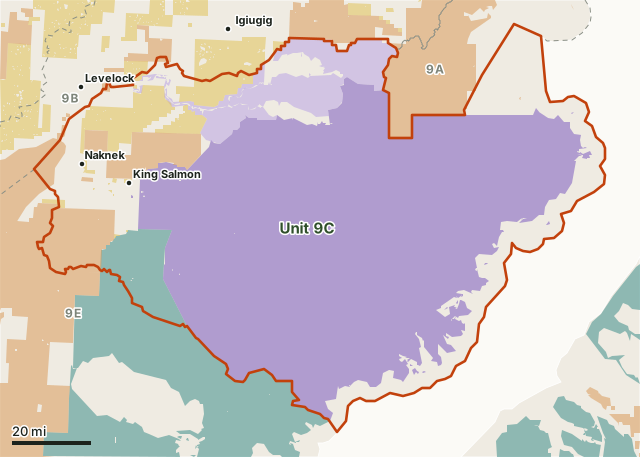
National wildlife refuge (FWS)National park or monument (NPS)National preserve (NPS)Bureau of Land ManagementState of AlaskaThis unitNeighboring unit lineHighway
| Size | 9,008 square miles (ADF&G) |
|---|---|
| ADF&G region | Region IV |
| Moose, 2025 | 51 of 138 hunters took one (37%) |
| Caribou, 2025 | 33 of 49 hunters took one (67%) |
| Federal land (PAD-US) | 76.1% |
| State land (PAD-US) | 5.8% |
| Largest public areas | Katmai National Park, Katmai National Preserve and BLM Anchorage Field Office |
| Communities | King Salmon, Naknek and South Naknek |
| Highways | None: access is by air, water or trail |
| Neighboring units | 9A, 9B, 9E |
How many moose do hunters take in Unit 9C?
Unit 9C drew 138 moose hunters in 2025, 45th of the 72 subunits with moose hunters. 51 of them took one (37%); 80% of the hunters were Alaska residents.
| Season | Hunters | Moose taken | Success | Resident hunters | Nonresident hunters | Males | Females |
|---|---|---|---|---|---|---|---|
| 2020 | 106 | 29 | 27% | 99 | 7 | 29 | 0 |
| 2021 | 84 | 22 | 26% | 73 | 11 | 22 | 0 |
| 2022 | 108 | 33 | 31% | 91 | 17 | 33 | 0 |
| 2023 | 131 | 43 | 33% | 106 | 25 | 43 | 0 |
| 2024 | 131 | 37 | 28% | 101 | 30 | 37 | 0 |
| 2025 | 138 | 51 | 37% | 110 | 28 | 51 | 0 |
How moose hunters in 9C got to the field in 2025, by ADF&G's transportation report: boat 51 hunters (17 successful), airplane 41 hunters (19 successful), 3 or 4 wheeler 31 hunters (7 successful) and snowmachine 7 hunters (4 successful).
Source: ADF&G Harvest General Reports, moose, reports 330 (success by residency), 130 (sex of the harvest) and 390 (transportation), regulatory years 2020 to 2025. A regulatory year runs July 1 to June 30. ADF&G labels these reports interim: late hunt reports can still change them.
How many caribou do hunters take in Unit 9C?
Unit 9C drew 49 caribou hunters in 2025, 17th of the 53 subunits with caribou hunters. 33 of them took one (67%); 100% of the hunters were Alaska residents. ADF&G's sex table places the 2025 harvest in Alaska Peninsula North (33) (herds).
| Season | Hunters | Caribou taken | Success | Resident hunters | Nonresident hunters | Males | Females |
|---|---|---|---|---|---|---|---|
| 2020 | 52 | 23 | 44% | 52 | 0 | 22 | 1 |
| 2021 | 58 | 24 | 41% | 58 | 0 | 24 | 0 |
| 2022 | 56 | 26 | 46% | 55 | 1 | 25 | 0 |
| 2023 | 46 | 20 | 43% | 45 | 1 | 19 | 1 |
| 2024 | 19 | 6 | 32% | 18 | 1 | 6 | 0 |
| 2025 | 49 | 33 | 67% | 49 | 0 | 31 | 2 |
How caribou hunters in 9C got to the field in 2025, by ADF&G's transportation report: snowmachine 36 hunters (25 successful), 3 or 4 wheeler 6 hunters (4 successful), airplane 5 hunters (4 successful) and boat 1 hunters (0 successful).
Source: ADF&G Harvest General Reports, caribou, reports 330 (success by residency), 130 (sex of the harvest) and 390 (transportation), regulatory years 2020 to 2025. A regulatory year runs July 1 to June 30. ADF&G labels these reports interim: late hunt reports can still change them.
Who manages the land in Unit 9C?
USGS PAD-US maps 81.9% of Unit 9C as public or tribal land. By manager:
| Manager | Acres | Share of the unit |
|---|---|---|
| National park or monument (NPS) | 3,625,597 | 62.9% |
| State of Alaska | 332,370 | 5.8% |
| National preserve (NPS) | 328,414 | 5.7% |
| Bureau of Land Management | 227,575 | 3.9% |
| National wildlife refuge (FWS) | 183,162 | 3.2% |
| Other National Park Service land | 25,697 | 0.4% |
| Not in PAD-US | 1,042,552 | 18.1% |
Named areas inside 9C: Katmai National Park (3,625,605 acres, 62.9%), Katmai National Preserve (328,520 acres, 5.7%), BLM Anchorage Field Office (227,646 acres, 3.9%), State Patented (190,970 acres, 3.3%), Becharof National Wildlife Refuge (183,159 acres, 3.2%) and State Tentatively Approved (111,995 acres, 1.9%).
Source: USGS PAD-US 4.1, fee land by manager, measured inside ADF&G's boundary by FilledTag.
Federal law sets what each kind of land allows. A national preserve in Alaska is run like a national park except that sport hunting, subsistence hunting and trapping are allowed (16 U.S.C. 3201); national park and monument land is closed to sport hunting. On federal public land, rural Alaska residents can also hunt under federal subsistence rules, and the Federal Subsistence Board can close federal land to other hunters for a species. Land PAD-US does not map is mostly private, including Alaska Native corporation land, and needs the owner's permission.
Which areas of Unit 9C have special restrictions?
- Naknek Controlled Use Area (controlled use area): Closed to the use of any motorized vehicle except an aircraft, boat, or snowmachine for hunting, including the transportation of hunters, their hunting gear, or parts of game, from August 1 through November 30; however, this provision does not apply to a motorized vehicle on the Naknek-King Salmon, Lake Camp, and Rapids Camp roads, and on the Pike Ridge and King Salmon Creek trails, and on frozen surfaces of the Nakn...
Source: ADF&G areas with restrictions, GMU 9. Read the full boundary there before hunting near one.
What communities and roads are in Unit 9C?
Census places inside 9C: King Salmon, Naknek and South Naknek. No state or federal highway crosses it, so hunters reach it by plane, boat, snowmachine or on foot.
Communities and highways: U.S. Census Bureau TIGER/Line and Gazetteer 2024.
Do nonresidents need a guide in Alaska?
For three species, yes. ADF&G's 2026-2027 drawing supplement: "Nonresidents who are citizens of the United States are required to be personally accompanied in the field by an Alaska-licensed guide OR an Alaska resident relative 19 years of age or older within the second-degree of kindred when hunting brown/grizzly bear, Dall sheep, or mountain goat." Nonresidents who are not U.S. citizens need a licensed guide for those and for every other big game species, by ADF&G's guide requirements. Moose, caribou, black bear, bison, muskox, elk and deer need no guide for a nonresident U.S. citizen.
Questions hunters ask
How many moose are taken in Unit 9C?
ADF&G's interim harvest report counts 51 moose reported from Unit 9C in the 2025 regulatory year, by 138 hunters. From 2020 to 2025 the yearly count of successful hunters ran from 22 (2021) to 51 (2025).
Who manages the land in Unit 9C?
USGS PAD-US maps 76.1% of Unit 9C as federal land and 5.8% as State of Alaska land; the largest named areas are Katmai National Park (63%), Katmai National Preserve (6%) and BLM Anchorage Field Office (4%). The rest is land PAD-US does not list, mostly private and Alaska Native corporation land.
Do nonresidents need a guide in Unit 9C?
Only for brown bear, Dall sheep and mountain goat: ADF&G requires nonresidents to be accompanied by an Alaska-licensed guide or an Alaska resident relative 19 or older within the second degree of kindred for brown bear, Dall sheep and mountain goat. Nonresidents who are not U.S. citizens need a guide for all big game.
Are there closed or controlled use areas in Unit 9C?
Yes. ADF&G lists Naknek Controlled Use Area in Unit 9C.
Get an Alaska hunt plan when they open
Alaska plans are not open yet. They are coming soon. Join the waiting list; the first 50 hunters get one plan free.
Use the map while you wait for your plan.
Where these numbers come from
- Harvest, hunters and success: ADF&G Harvest General Reports, interim, regulatory years 2020 to 2025; each table checked against ADF&G's printed totals.
- Drawing results: ADF&G 2026-2027 Drawing Permit Hunt Supplement and the two before it. Restrictions: ADF&G areas with restrictions.
- Boundary: ADF&G Game Management Subunits. Land: USGS PAD-US. Communities and highways: U.S. Census Bureau.
FilledTag is not part of the Alaska Department of Fish and Game. ADF&G's regulations and emergency orders are the final word.