Hawaiʻi Island hunting: public hunting units, rules and map
Hawaii Island has 10 public hunting units covering 681,125 acres, 26% of its 2,581,209 acres of land, by the Hawaii Statewide GIS Program's hunting areas layer. The largest is Unit B at 217,232 acres. DLNR lists these game mammals for the island: feral pig, mouflon sheep, feral sheep, mouflon-feral hybrid sheep and feral goat. DLNR's adaptive management changes in force since May 18, 2026 replace the rules of 7 units.
Data updated October 2026. Rules: DLNR's Hawaii Island exhibits of HAR 13-123 and 13-122. Units and acres: Hawaii Statewide GIS Program.
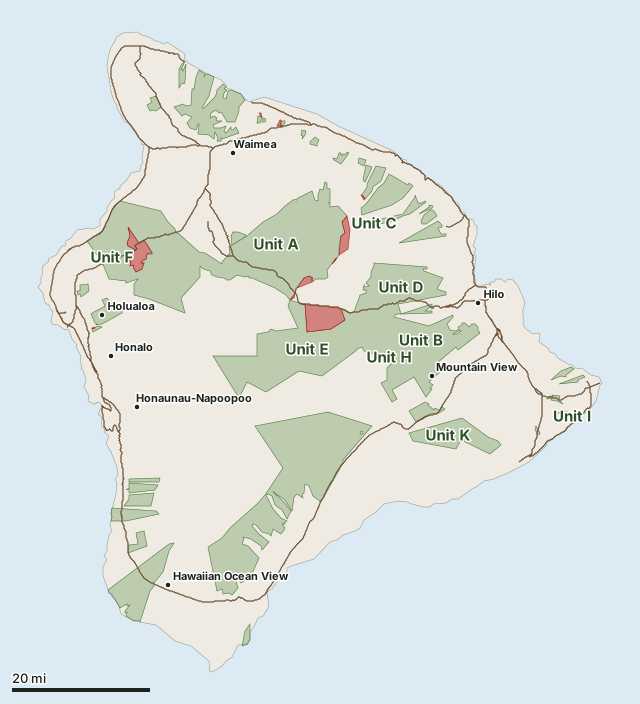
Public hunting unitSafety zone or no huntingHighway
What are the public hunting units on Hawaii Island?
| Unit | Acres | Game mammals | Open days | Rule change |
|---|---|---|---|---|
| Unit A | 75,086 | feral pigs, wild sheep and feral goats | Daily, except on legal fall game bird hunting days, and during spring turkey season (Mar 1- Apr 15), when firearm... | Amended 2026 |
| Unit B | 217,232 | feral pigs, wild sheep and feral goats | Daily | |
| Unit C | 5,224 | feral pigs and wild sheep | Saturday, Sunday and State Holidays | |
| Unit D | 42,004 | feral pigs, wild sheep and feral goats | Daily; Saturday, Sunday, and State Holidays | Amended 2026 |
| Unit E | 142,274 | feral pigs, wild sheep and feral goats | Daily, subject to training; Fridays, Saturdays, Sundays, and State Holidays | Amended 2026 |
| Unit F | 50,928 | feral pigs, wild sheep and feral goats | Fridays, Saturdays, Sundays, and State Holidays | Amended 2026 |
| Unit G | 7,268 | feral pigs, feral goats and wild sheep | Daily | Amended 2026 |
| Unit H | 11,863 | feral pigs and feral goats | Saturday, Sunday, and State Holidays | |
| Unit I | 6,079 | feral pigs and feral goats | Daily | Amended 2026 |
| Unit K | 88,883 | feral pigs, feral goats and wild sheep | Daily; Daily, except on legal fall game bird hunting days | Amended 2026 |
Sources: Hawaii Statewide GIS Program, Hunting Areas; HAR 13-123, Hawaii Island exhibit; DLNR adaptive management changes.
Game bird only areas in the layer: Kahua/Ponoholo Ranch Speical Permit Area (bird unit J, 1,647 acres), Kapapala Ranch Cooperative G.M.A. (bird unit J, 28,428 acres), Kaohe Restoration Area (bird unit G, 1,530 acres) and Puu Mali Mitigation (bird unit A, 4,403 acres).
What are the game bird rules on Hawaii Island?
| Game birds | Daily bag | Open period | Open days | Conditions |
|---|---|---|---|---|
| Pheasant species other than Nepal kalij | Three (cocks only) per hunter, which may be of one species or a combination of species | First Saturday in November through the last Sunday in January. | Saturdays, Sundays, and State Holidays. Additionally, Wednesday, Thursdays for Units A, G, PTA, and private lands**** | Public land and private lands |
| Nepal Kalij Pheasant | Three birds of either sex per hunter | First Saturday in November through the last Sunday in January. | Saturdays, Sundays, and State Holidays. Additionally, Wednesday, Thursdays for Units A, G, PTA, and private lands**** | Public land and private lands |
| California Valley Quail Japanese Quail Gambels' Quail | Fifteen birds of either sex per hunter,which may be of any one species or a combination ofspecies | First Saturday in November through the last Sunday in January. | Saturdays, Sundays, and State Holidays. Additionally, Wednesday, Thursdays for Units A, G, PTA, and private lands**** | Public land and private lands |
| Chukar Partridge Gray Francolin Black Francolin | Eight birds of either sex per hunter, which may be of any one species or a combination of these species | First Saturday in November through the last Sunday in January. | Saturdays, Sundays, and State Holidays. Additionally, Wednesday, Thursdays for Units A, G, PTA, and private lands**** | Public land and private lands |
| Erckel's Francolin | Three birds of either sex per hunter | First Saturday in November through the last Sunday in January. | Saturdays, Sundays, and State Holidays. Additionally, Wednesday, Thursdays for Units A, G, PTA, and private lands**** | Public land and private lands |
| Chestnut bellied Sandgrouse Mourning Dove Spotted Dove (Large Dove) | Ten birds of either sex per hunter, which may be of any one species or a combination of these species | First Saturday in November through the last Sunday in January. | Saturdays, Sundays, and State Holidays. Additionally, Wednesday, Thursdays for Units A, G, PTA, and private lands**** | Public land and private lands |
| Barred Dove (Small Dove) | Twenty birds of either sex per Hunter | First Saturday in November through the last Sunday in January. | Saturdays, Sundays, and State Holidays. Additionally, Wednesday, Thursdays for Units A, G, PTA, and private lands**** | Public land and private lands |
| Wild Turkey | One bird of either sex per hunter | First Saturday in November through the last Sunday in January. | Saturdays, Sundays, and State Holidays. Additionally, Wednesday, Thursdays for Units A, G, PTA, and private lands**** | Public land and private lands |
| Barred Dove (Small Dove) | Twenty birds of either sex per hunter | First Saturday in February through last Sunday in March. | Saturdays, Sundays, and State Holidays. | On private lands only |
| Spotted Dove (Large Dove) | Ten birds per hunter | First Saturday in October thru the last Sunday in October | Saturdays, Sundays, and State Holidays. | On private lands only |
| Wild Turkey (Spring Hunt Only) (amended 2026) | Three bearded turkeys per season*** | March 1 through March 31, Kipuka Ainahou** | Daily | *Permit and tag required for public and private areas. No dogs allowed. |
| Wild Turkey (Spring Hunt Only) (amended 2026) | March 1 through April 15, Units A, C, E, F, and G, and private lands | Daily and concurrent with mammal hunting days at Unit F, Puu Waawaa Forest Reserve (makai) and Unit E, Puu Anahulu Game Management Area (GMA), East Section | *Permit and tag required for public and private areas. No dogs allowed. Units E & F – Archery only, to run concurrently during mammal archery only season. No firearms. |
Source: HAR 13-122, Hawaii Island game bird exhibit; spring turkey rows from DLNR's adaptive management amendment, effective May 18, 2026; DLNR game bird hunting.
How many safety zones and closed areas does Hawaii Island have?
The state GIS layer marks 2 safety zones and 12 closed or no hunting areas on Hawaii Island. Each unit page lists the ones in or touching it.
What do you need to hunt in Hawaii?
By DLNR's game mammal page: a Hawaii hunting license ($10 for residents, $95 for nonresidents), a current $10 Hawaii Wildlife Conservation Stamp, and proof of a hunter education course recognized by the National Hunter Education Association. Anyone who hunts or helps a hunter in a public hunting area must wear an exterior blaze orange garment. Some units need a permit, tag or lottery drawing on top: see DLNR game mammal hunting and DLNR's hunt applications.
Questions hunters ask
Where can you hunt on Hawaii Island?
In 10 DOFAW public hunting units (Unit A, Unit B, Unit C, Unit D, Unit E, Unit F, Unit G, Unit H, Unit I and Unit K), 681,125 acres in all, and on private land with the owner's permission.
What game animals are on Hawaii Island?
DLNR lists feral pig, mouflon sheep, feral sheep, mouflon-feral hybrid sheep and feral goat for Hawaii Island, plus game birds in season.
What is the largest hunting unit on Hawaii Island?
Unit B, 217,232 acres, then Unit E (142,274 acres), in the state GIS layer.
When is game bird season on Hawaii Island?
Pheasant species other than Nepal kalij: First Saturday in November through the last Sunday in January; Saturdays, Sundays, and State Holidays. Additionally, Wednesday, Thursdays for Units A, G, PTA, and private lands****, by DLNR's exhibit of HAR 13-122.
Get a Hawaii hunt plan when they open
Hawaii plans are not open yet. They are coming soon. Join the waiting list; the first 50 hunters get one plan free.
Use the map while you wait for your plan.
Where these facts come from
- DLNR: Hunt Hawaii Island; HAR 13-123 and HAR 13-122.
- Hawaii Statewide GIS Program, Hunting Areas; U.S. Census Bureau island outlines, towns and highways.
FilledTag is not part of the Hawaii Department of Land and Natural Resources.