Big Bend Wildlife Area: hunting, units and access
The Big Bend Wildlife Area is 24,202 acres of land managed by WDFW in Region 2, inside GMU 248, measured from WDFW's boundary. Of the GMUs it touches, WDFW reports the most deer taken in GMU 248: 126 in 2025.
Data updated October 2026. Area facts: WDFW's page for the Big Bend Wildlife Area, read 2026-10-18, and WDFW's facility data. Harvest: WDFW reports to 2025.
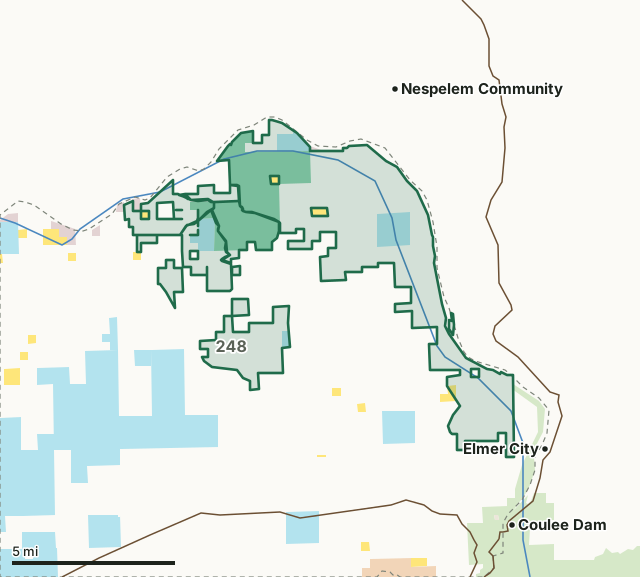
BLMDNR state trust landWDFW landBureau of ReclamationNational recreation areaMilitary land (restricted)Other public (parks, county, city, other agencies)Big Bend Wildlife AreaGMU lineLake or riverHighway
| Size | 24,202 acres (WDFW boundary, measured by FilledTag); WDFW's page says 24,189 acres |
|---|---|
| WDFW region | Region 2, North Central Washington |
| GMUs | GMU 248 |
| Roads and trails | 36 miles |
| Nearest towns | Elmer City (next to it), Coulee Dam (2 mi) and Grand Coulee (4 mi) |
What is the Big Bend Wildlife Area like?
The Big Bend Unit presents a dramatic landscape sculpted 15,000 to 12,000 years ago by the Okanogan Lobe of the Cordilleran Ice Sheet. The unit is comprised of basalt cliffs, rolling hills peppered with basalt haystack rocks, low buttes that overlook the Columbia River, riparian draws, permanent and seasonal creeks, and rugged slopes filled with Ponderosa pine.
The Big Bend Wildlife Unit is located 14 miles north of Grand Coulee on the south shore of the Columbia River in northeast Douglas County. The unit is accessed from the Strahl Canyon, Alameda Flats, Twin Springs, China Creek, Smith Lake, and Barry and Pendell roads.
In WDFW's words, from WDFW's Big Bend Wildlife Area page.
What are WDFW's hunting rules on the Big Bend Wildlife Area?
WDFW's hunting notes for the area, in its words:
- All lands in Washington State are CLOSED to the taking of sharp-tailed grouse and sage grouse. Upland bird hunters are advised that sharp-tailed grouse and sage grouse are protected species and can be found anywhere on the unit. Hunters should be alert to the presence of these birds on this area and be proficient at identifying them.
- This area is in the Big Bend Game Management Unit # 248. Mule deer hunting is popular, so expect crowded conditions during the modern firearm season, especially opening weekend. Some hunters access the area by boat. The area has an abundance of wild turkeys and is open for the spring turkey hunting season. Upland game bird hunters can expect to find gray partridge, chukar, California quail, and dusky grouse.
- The area is available to disabled hunters during the archery, muzzleloader and modern firearm seasons through the Road Access Entry Program and Drawing.
From WDFW's Big Bend Wildlife Area page. Seasons and legal animals follow the GMU the ground is in.
How many elk and deer are taken in the GMUs around the Big Bend Wildlife Area?
WDFW reports harvest by GMU, not by wildlife area. These are the whole GMUs the area lies in:
| GMU | Wildlife area acres in it | Elk taken, 2025 | Deer taken, 2025 | Bears taken, 2025 |
|---|---|---|---|---|
| GMU 248 Big Bend | 24,197 | 0 | 126 | 9 |
Harvest: WDFW Game Harvest Reports (GMU, 2025). Wildlife area acres in each GMU measured by FilledTag from WDFW's boundaries.
How do you get to the Big Bend Wildlife Area?
Highways within 5 miles: SR 155 and SR 174. Nearest towns: Elmer City (next to it), Coulee Dam (2 miles), Grand Coulee (4 miles) and Nespelem (4 miles).
WDFW's access notes:
- China Creek Road, Twin Springs Road, and other county roads in the vicinity are unimproved and may be impassable in wet weather, especially in spring. In winter months, these roads and most adjacent county roads are not plowed, so visitors travel at their own risk.
- Motorized vehicles and ebikes are prohibited.
- Mountain biking is only allowed on interior service roads of the unit.
- Open fires are not permitted at any time during the year.
- There is no parking on county roads, please allow sufficient room for traffic to pass safely if pulled to the side.
Questions hunters ask
Do you need a pass to park at the Big Bend Wildlife Area?
Yes. Parking on WDFW land needs the Vehicle Access Pass that comes with most annual hunting and fishing licenses, or a Discover Pass, displayed where it can be seen from outside the vehicle (WDFW pamphlet, page 72).
Which GMUs is the Big Bend Wildlife Area in?
All of it is in GMU 248 Big Bend, by WDFW's boundaries. Seasons follow that GMU's rules.
Can you camp on the Big Bend Wildlife Area?
WDFW's facility data lists no developed campground on the Big Bend Wildlife Area. Camping on WDFW land follows WDFW's public conduct rules and any closures posted for the area; check WDFW's page before planning a camp.
Get a Washington hunt plan when they open
Hunt plans for Washington are coming. Join the list and you'll hear first. The first 50 hunters in each new state get their plan free.
Until then, the free FilledTag app for iPhone has a map that works in every state, Washington included.
Where these facts come from
- Area description, rules and access notes: WDFW, Big Bend Wildlife Area.
- Boundary, units and facilities: WDFW wildlife area and unit boundaries. Surrounding public land: WA DNR Major Public Lands (non-DNR) and WA DNR Managed Land Parcels, read 2026-10.
- GMU harvest: WDFW Game Harvest Reports. Parking passes: WDFW 2026 Big Game Hunting Seasons and Regulations, page 72.
FilledTag is not part of Washington Department of Fish and Wildlife. Numbers are copied from WDFW and the State of Washington, or measured from their maps; nothing on this page is estimated by FilledTag. WDFW's regulations are the final word on every rule.