Fairbanks Landing Fish and Wildlife Area: hunting and access
Fairbanks Landing Fish and Wildlife Area is 8,788 acres open to public hunting in Sullivan and Vigo counties, next to Fairbanks, managed by the DNR's Division of Fish and Wildlife. Hunters took 1,952 deer in Sullivan County in 2025.
Data updated October 2026. Area facts: the DNR's DNR property open to hunting data, read 2026-10. Harvest: Indiana DNR deer reports, 2021 to 2025.
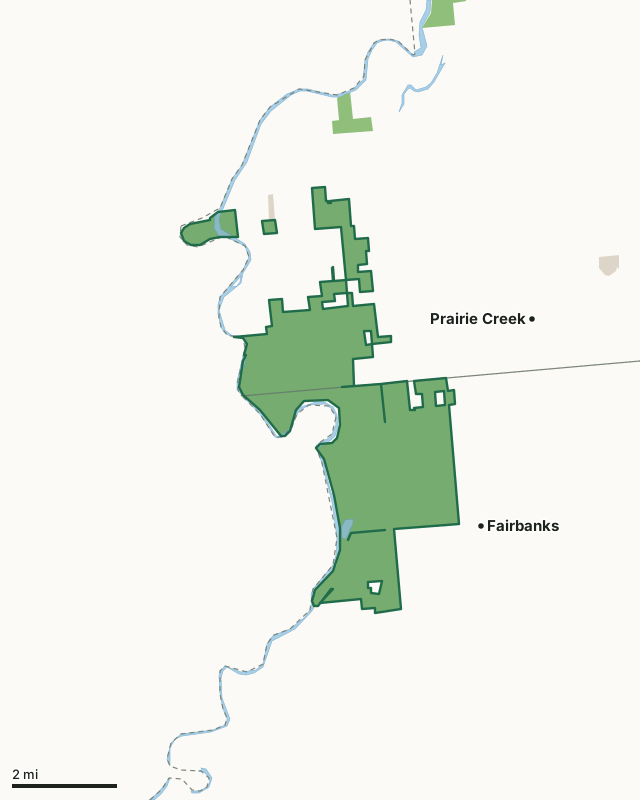
Properties open to public hunting (DNR map)County, city and regional landFairbanks Landing Fish and Wildlife AreaCounty lineLakeHighway
| Size | 8,788 acres in 4 pieces |
|---|---|
| Counties | Sullivan County and Vigo County |
| Deer harvest unit | Sullivan County, Vigo County |
| DNR lists for hunting | Quail, Turkey, Rabbit, Deer, Woodcock, Duck, Goose, Raccoon and Fox |
| Managed by | the DNR's Division of Fish and Wildlife |
| DNR contact | Goose Pond FWA 812-659-9901 |
| Hunter check-in (DNR) | Required: self-serve |
| Nearest towns | Fairbanks (next to it), Prairie Creek (2 mi) and Graysville (6 mi) |
What can you hunt on Fairbanks Landing Fish and Wildlife Area?
In the DNR's words: Quail, turkey, rabbit, deer, woodcock. Duck and goose hunting from non-blind areas along riverfront. Night hunting for raccoon and fox.
What are the rules on Fairbanks Landing Fish and Wildlife Area?
Antlerless deer may not be taken with a firearm during the firearms season on DNR Fish and Wildlife properties and at Mississinewa, Patoka and Salamonie lakes (DNR).
Hunters must check in at the property; the DNR's property page says how.
Indiana's statewide bag limit is 1 antlered and 6 antlerless deer, within each county's antlerless limit (DNR).
How many deer are taken around Fairbanks Landing Fish and Wildlife Area?
Fairbanks Landing Fish and Wildlife Area lies in 2 counties. Hunters took 1,952 deer in Sullivan County in 2025, against 1,902 in 2024.
| County | Fairbanks Landing Fish and Wildlife Area acres in it | Deer, 2025 | Deer, 2024 | Deer, 2023 |
|---|---|---|---|---|
| Sullivan County | 5,508 | 1,952 | 1,902 | 1,726 |
| Vigo County | 3,276 | 1,685 | 1,608 | 1,470 |
Harvest for the whole county, not the property alone: Indiana DNR White-tailed Deer Reports (2021 to 2025 seasons, Table 3-4).
How do you get to Fairbanks Landing Fish and Wildlife Area?
Nearest towns: Fairbanks (next to it), Prairie Creek (2 miles), Graysville (6 miles) and Prairieton (6 miles).
What other public land is near Fairbanks Landing Fish and Wildlife Area?
Properties open to public hunting within 10 miles:
- HRI Wabash River: 564 acres, 1 mile away
- Wabash River Conservation Area: 1,698 acres, 3.5 miles away
- Wabashiki Fish and Wildlife Area: 3,710 acres, 5.2 miles away
Public land within 3 miles of Fairbanks Landing Fish and Wildlife Area
Counting Fairbanks Landing Fish and Wildlife Area itself, 9,026 of the 74,622 acres within 3 miles of its boundary are public land open to the public (12.1%), by USGS PAD-US 4.1 and the DNR's public hunting property boundaries.
| Manager | Acres within 3 miles |
|---|---|
| Properties open to public hunting (DNR map) | 8,994 |
| County, city and regional land | 32 |
Questions hunters ask
Where is Fairbanks Landing Fish and Wildlife Area?
In Sullivan and Vigo counties, next to Fairbanks.
What can you hunt on Fairbanks Landing Fish and Wildlife Area?
The DNR lists: Quail, turkey, rabbit, deer, woodcock. Duck and goose hunting from non-blind areas along riverfront. Night hunting for raccoon and fox.
How much public land is around Fairbanks Landing Fish and Wildlife Area?
9,026 acres within 3 miles of its boundary, Fairbanks Landing Fish and Wildlife Area included, by USGS PAD-US 4.1 and the DNR's public hunting property boundaries. The closest other public hunting property is HRI Wabash River (1 mile).
Get a Indiana hunt plan when they open
Hunt plans for Indiana are coming. Join the list and you'll hear first. The first 50 hunters in each new state get their plan free.
Until then, the free FilledTag app for iPhone has a map that works in every state, Indiana included.
Where these facts come from
- Area description, species, rules and directions: DNR, Fairbanks Landing Fish and Wildlife Area; Indiana DNR properties with public hunting (managed lands layer).
- Boundary and acres: the DNR's map layer above. Surrounding public land: USGS PAD-US 4.1 (fee land open to the public) and the DNR's public hunting property boundaries.
- Deer harvest: Indiana DNR White-tailed Deer Reports (2021 to 2025 seasons, Table 3-4).
FilledTag is not part of the Indiana Department of Natural Resources. Check the DNR's rules and posted signs before you go.