Birch Hill Wildlife Management Area: hunting, access and parking in Zone 5
Birch Hill Wildlife Management Area is 4,561 acres of MassWildlife land in Royalston, Templeton and Winchendon (Worcester County), in Wildlife Management Zone 5. MassWildlife says all of its WMAs are open to hunting, fishing and trapping. Hunters took 917 deer in Zone 5 in 2025.
Data updated October 2026. Area facts: MassWildlife's Birch Hill WMA fact sheet. Harvest: MassWildlife 2025 Deer Harvest Summary. Seasons: MassWildlife deer hunting regulations (2026 dates).
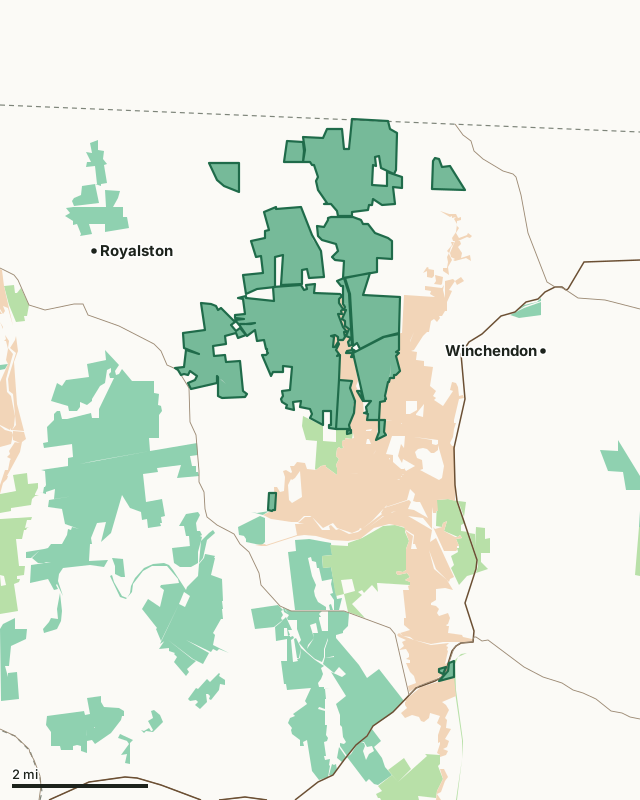
MassWildlife (Fish and Game) landState forest and park land (DCR)Army Corps of EngineersBirch Hill WMAZone lineHighway
| Size | 4,561 acres (MassWildlife), in 19 pieces |
|---|---|
| Town | Royalston, Templeton and Winchendon |
| County | Worcester |
| Wildlife Management Zone | Zone 5 |
| MassWildlife district | Central District |
| Parking (MassWildlife) | None mapped |
| Pheasant | Stocked; blaze orange hat required in pheasant season |
| Deer taken in Zone 5, 2025 | 917 (541 adult males) |
| Nearest town centers | Royalston (2 mi), Winchendon (2 mi) and Templeton (2 mi) |
What is Birch Hill WMA like?
MassWildlife describes it: "Birch Hill WMA is made up of several parcels totaling over 4,500 acres and is adjacent to other large areas of conserved land. The property contains mixed hardwood and conifer forests, open fields, old apple orchards, shrublands, and several wetland complexes. Extensive sand and gravel deposits left by glaciers give rise to a globally rare type of habitat known as barrens. The Priest Brook Barrens contain dense lowbush blueberry, pitch pine, scrub oak, and native grasses that support an abundance of rare and common wildlife. Several maintenance roads and unmarked trails wind through the WMA and can be used for walking, hiking, birding, cross-country skiing, and hunting access."
On its habitat work: "MassWildlife is working at this WMA to restore and maintain barrens along with a mosaic of forested habitat types, so visitors may see operations like mowing, prescribed fire, and tree thinning taking place periodically. Take time to explore these carefully restored areas and the native wildlife they support."
On wildlife: "Visitors will find excellent bird watching, wildlife viewing, and nature study opportunities. Birch Hill WMA is home to fishers, foxes, beavers, moose, and great blue herons. Prairie warblers, eastern whip-poor-wills, ruffed grouse, and American woodcocks frequent dense regenerating young forests that grow after active habitat management. The barrens habitat in the Priest Brook Valley supports highly specialized species including many state-listed moths and butterflies, tiger beetles, and a variety of native bees."
Quoted from MassWildlife's Birch Hill WMA fact sheet.
What does MassWildlife say about hunting Birch Hill WMA?
"Hunters will find sign of white-tailed deer, wild turkeys, and black bears. Ruffed grouse, eastern cottontail rabbits, coyotes, and foxes can also be found here. Ducks and geese frequent the small ponds and marshes in the northern part of the WMA. Ring-necked pheasants are stocked throughout the fall season. Priest Brook and Scott Brook provide fishing opportunities for stocked trout. There is cartop boat access to both waterbodies at road crossings. These two brooks flow into the Millers River, which is also stocked with trout."
Its rules for the area: "During pheasant season, a blaze orange hat must be worn by all hunters except while night-hunting raccoons or opossums or while hunting waterfowl from within a blind or boat."
How do you get into Birch Hill WMA?
"Access to the property is gained from New Boston Road, Norcross Road, Winchendon Road, and Turnpike Road. Portions of this property are accessible seasonally and subject to weather conditions."
MassWildlife's parking layer shows no lot for Birch Hill WMA.
Highways within five miles: MA 68, MA 2, US 202, MA 32, MA 101 and MA 12. Distances to the nearest town centers: Royalston 2 miles, Winchendon 2 miles, Templeton 2 miles and Phillipston 4 miles. Other WMAs nearby: Millers River (3 miles), Lawrence Brook (4 miles), Tully Mountain (6 miles).
When can you hunt deer on Birch Hill WMA in 2026?
Deer seasons follow Zone 5: archery October 5 to November 28, shotgun November 30 to December 12, primitive firearms December 14 to 31. In 2025 the zone gave 337 deer to archers and 411 in shotgun season.
| Zone | WMA acres in it | Deer, 2025 | Adult males, 2025 | Deer, 2024 |
|---|---|---|---|---|
| Zone 5 | 4,638 | 917 | 541 | 798 |
Seasons: MassWildlife deer hunting regulations (2026 dates). Harvest: MassWildlife 2025 Deer Harvest Summary; MassWildlife 2024 Deer Harvest Summary.
What rules apply on Birch Hill WMA?
It is stocked with pheasant, so every hunter must wear a blaze orange hat during pheasant season, except raccoon and opossum hunters at night and waterfowl hunters in a blind or boat. Under 321 CMR 3.01, camping, fires and target practice need the Director's written permission, vehicles stay on roads open to traffic, and dogs must be leashed unless hunting or training with a licensed hunter.
Source: MassWildlife WMA regulations.
Questions hunters ask
Can you hunt on Birch Hill WMA?
Yes. MassWildlife says all WMAs are open to hunting, fishing and trapping; deer seasons follow Zone 5, where the 2026 shotgun season runs November 30 to December 12 (MassWildlife WMA regulations).
What zone is Birch Hill WMA in?
Zone 5, as MassWildlife's fact sheet gives it. Hunters took 917 deer in Zone 5 in 2025, 541 of them adult males, after 798 in 2024 (MassWildlife 2025 Deer Harvest Summary).
How do you get into Birch Hill WMA?
MassWildlife's fact sheet: "Access to the property is gained from New Boston Road, Norcross Road, Winchendon Road, and Turnpike Road. Portions of this property are accessible seasonally and subject to weather conditions."
What can you hunt on Birch Hill WMA?
MassWildlife's fact sheet: "Hunters will find sign of white-tailed deer, wild turkeys, and black bears. Ruffed grouse, eastern cottontail rabbits, coyotes, and foxes can also be found here. Ducks and geese frequent the small ponds and marshes in the northern part of the WMA. Ring-necked pheasants are stocked throughout the fall season. Priest Brook and Scott Brook provide fishing opportunities for stocked trout."
Get a Massachusetts hunt plan when they open
Hunt plans for Massachusetts are coming. Join the list and you'll hear first. The first 50 hunters in each new state get their plan free.
Until then, the free FilledTag app for iPhone has a map that works in every state, Massachusetts included.
Sources: MassWildlife fact sheet; MassWildlife Lands (MassGIS); MassWildlife parking for recreation; MassWildlife 2025 Deer Harvest Summary; MassWildlife deer hunting regulations (2026 dates); MassWildlife WMA regulations; public land MassGIS Protected and Recreational OpenSpace for state and Army Corps land; USGS Protected Areas Database of the United States (PAD-US 4.1) for federal land; towns U.S. Census Bureau TIGER/Line 2024 primary and secondary roads; U.S. Census Bureau 2024 Gazetteer, towns (county subdivisions). FilledTag is not part of Massachusetts Division of Fisheries and Wildlife (MassWildlife).