Martin H. Burns Wildlife Management Area: hunting, access and parking in Zone 10
Martin H. Burns Wildlife Management Area is 2,135 acres of MassWildlife land in Newbury and West Newbury (Essex County), in Wildlife Management Zone 10. MassWildlife says all of its WMAs are open to hunting, fishing and trapping. Hunters took 2,515 deer in Zone 10 in 2025, and MassWildlife maps 5 parking areas for the property with room for about 32 vehicles.
Data updated October 2026. Area facts: MassWildlife's Martin H. Burns WMA fact sheet. Harvest: MassWildlife 2025 Deer Harvest Summary. Seasons: MassWildlife deer hunting regulations (2026 dates).
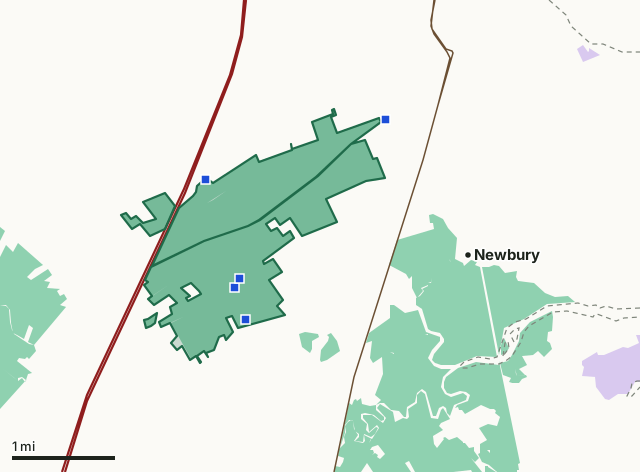
MassWildlife (Fish and Game) landNational wildlife refugeMartin H. Burns WMAZone lineParkingHighway
| Size | 2,135 acres (MassWildlife), in 4 pieces |
|---|---|
| Town | Newbury and West Newbury |
| County | Essex |
| Wildlife Management Zone | Zone 10 |
| MassWildlife district | Northeast District |
| Parking (MassWildlife) | 5 lots, about 32 spaces |
| Pheasant | Stocked; blaze orange hat required in pheasant season |
| Deer taken in Zone 10, 2025 | 2,515 (1,320 adult males) |
| Nearest town centers | Newbury (under a mile), Newburyport (2 mi) and West Newbury (2 mi) |
What is Martin H. Burns WMA like?
MassWildlife describes it: "This WMA is named for Martin H. Burns, a sportsman, farmer, and public servant who advocated for the protection of open space in the early 1950s. The property is part of a collection of conserved lands in the region. The shrublands, young forests, and mature woodlands support a diverse array of wildlife and plant species. The rocky terrain is interspersed by vernal pools, beaver ponds, streams, freshwater marshes, and forested swamps. Several maintenance roads wind through the WMA and can be used for walking, hiking, birding, cross-country skiing, and hunting access. For a wild experience, visitors can also explore unmarked trails, but please remember that marking or expanding trails is not permitted. MassWildlife manages shrublands and young forests with mowing and invasive plant treatment to maintain vigorous, healthy wildlife habitat. The headwaters of Cart Creek and Little River originate within the protected boundaries of the WMA. Cart Creek supports American eels and, occasionally, herring. Visit Haystack Boulder near the Scotland Road parking area and watch for other glacial erratic boulders in the area."
On its habitat work: "Shrubland and young forest habitat is maintained every 5-7 years by mowing and treating for invasive plants. Current projects include invasive plant species control and additional shrubland clearing. Open lands are managed for American woodcock and a variety of shrubland bird species."
On wildlife: "Vernal pools, marshes, shrublands, and forests provide habitat for a diversity of wildlife. Sightings of scarlet tanagers, rose-breasted grosbeaks, indigo buntings, and other songbirds are common, and you may even hear an eastern whip-poor-will after dark. At dusk, listen for the wing whirr of woodcock. Birdwatching is particularly rewarding in May during spring migration. Take time to explore the vernal pools and the unique wildlife found within them. Look for fairy shrimp, red-spotted newts, iridescent wood frog and green frog tadpoles, spotted salamanders, and snapping turtles. When walking along the beaver flowages, watch as ducklings learn to feed from their mothers and listen for the warning slap of a beaver’s tail."
Quoted from MassWildlife's Martin H. Burns WMA fact sheet.
What does MassWildlife say about hunting Martin H. Burns WMA?
"White-tailed deer, wild turkeys, foxes, eastern cottontail rabbits, squirrels, and coyotes can be found here. Woodcock are abundant in the managed shrubland and along maintenance roads. Beaver flowages and marshes are excellent for hunting waterfowl and trapping aquatic furbearers. Ring-necked pheasants are stocked throughout the fall season."
Its rules for the area: "During pheasant season, a blaze orange hat must be worn by all hunters except while night-hunting raccoon or opossum or while hunting waterfowl from within a blind or boat. A small target range, approximately in the center of the WMA, requires a special permit for use."
How do you get into Martin H. Burns WMA?
"The main entrance to the WMA is on Orchard Street. There is an additional pull-off available on Scotland Road."
| Parking | Spaces | Surface | Condition | Latitude | Longitude |
|---|---|---|---|---|---|
| Main entrance parking | 20 | Gravel | Good | 42.76162 | -70.91516 |
| Interior/Range parking | 4 | Dirt/Gravel | Good | 42.76621 | -70.91709 |
| Pull-off | 2 | Dirt | Good | 42.78146 | -70.92248 |
| Powerline gate | 3 | Gravel | Good | 42.78961 | -70.88797 |
| Target Range Parking | 3 | Dirt | Good | 42.76742 | -70.91626 |
From MassWildlife parking for recreation.
Highways within five miles: I-95, US 1, I-495, MA 113, MA 133 and MA 110. Distances to the nearest town centers: Newbury under a mile, Newburyport 2 miles, West Newbury 2 miles and Rowley 3 miles. Other WMAs nearby: William Forward (2 miles), Crane Pond (3 miles), Salisbury Salt Marsh (4 miles).
When can you hunt deer on Martin H. Burns WMA in 2026?
Deer seasons follow Zone 10: archery October 5 to November 28, shotgun November 30 to December 12, primitive firearms December 14 to 31 and a winter season January 1 to 30, 2027. In 2025 the zone gave 1,435 deer to archers and 645 in shotgun season.
| Zone | WMA acres in it | Deer, 2025 | Adult males, 2025 | Deer, 2024 |
|---|---|---|---|---|
| Zone 10 | 1,591 | 2,515 | 1,320 | 2,423 |
Seasons: MassWildlife deer hunting regulations (2026 dates). Harvest: MassWildlife 2025 Deer Harvest Summary; MassWildlife 2024 Deer Harvest Summary.
What rules apply on Martin H. Burns WMA?
It is stocked with pheasant, so every hunter must wear a blaze orange hat during pheasant season, except raccoon and opossum hunters at night and waterfowl hunters in a blind or boat. Under 321 CMR 3.01, camping, fires and target practice need the Director's written permission, vehicles stay on roads open to traffic, and dogs must be leashed unless hunting or training with a licensed hunter.
Source: MassWildlife WMA regulations.
Questions hunters ask
Can you hunt on Martin H. Burns WMA?
Yes. MassWildlife says all WMAs are open to hunting, fishing and trapping; deer seasons follow Zone 10, where the 2026 shotgun season runs November 30 to December 12 (MassWildlife WMA regulations).
What zone is Martin H. Burns WMA in?
Zone 10, as MassWildlife's fact sheet gives it. Hunters took 2,515 deer in Zone 10 in 2025, 1,320 of them adult males, after 2,423 in 2024 (MassWildlife 2025 Deer Harvest Summary).
Where do you park for Martin H. Burns WMA?
MassWildlife maps 5 parking areas: Main entrance parking (about 20 cars, gravel); Interior/Range parking (about 4 cars, dirt/gravel); Pull-off (about 2 cars, dirt); Powerline gate (about 3 cars, gravel). Its fact sheet adds: "The main entrance to the WMA is on Orchard Street. There is an additional pull-off available on Scotland Road."
What can you hunt on Martin H. Burns WMA?
MassWildlife's fact sheet: "White-tailed deer, wild turkeys, foxes, eastern cottontail rabbits, squirrels, and coyotes can be found here. Woodcock are abundant in the managed shrubland and along maintenance roads. Beaver flowages and marshes are excellent for hunting waterfowl and trapping aquatic furbearers. Ring-necked pheasants are stocked throughout the fall season."
Get a Massachusetts hunt plan when they open
Hunt plans for Massachusetts are coming. Join the list and you'll hear first. The first 50 hunters in each new state get their plan free.
Until then, the free FilledTag app for iPhone has a map that works in every state, Massachusetts included.
Sources: MassWildlife fact sheet; MassWildlife Lands (MassGIS); MassWildlife parking for recreation; MassWildlife 2025 Deer Harvest Summary; MassWildlife deer hunting regulations (2026 dates); MassWildlife WMA regulations; public land MassGIS Protected and Recreational OpenSpace for state and Army Corps land; USGS Protected Areas Database of the United States (PAD-US 4.1) for federal land; towns U.S. Census Bureau TIGER/Line 2024 primary and secondary roads; U.S. Census Bureau 2024 Gazetteer, towns (county subdivisions). FilledTag is not part of Massachusetts Division of Fisheries and Wildlife (MassWildlife).